
The shy brown hyena
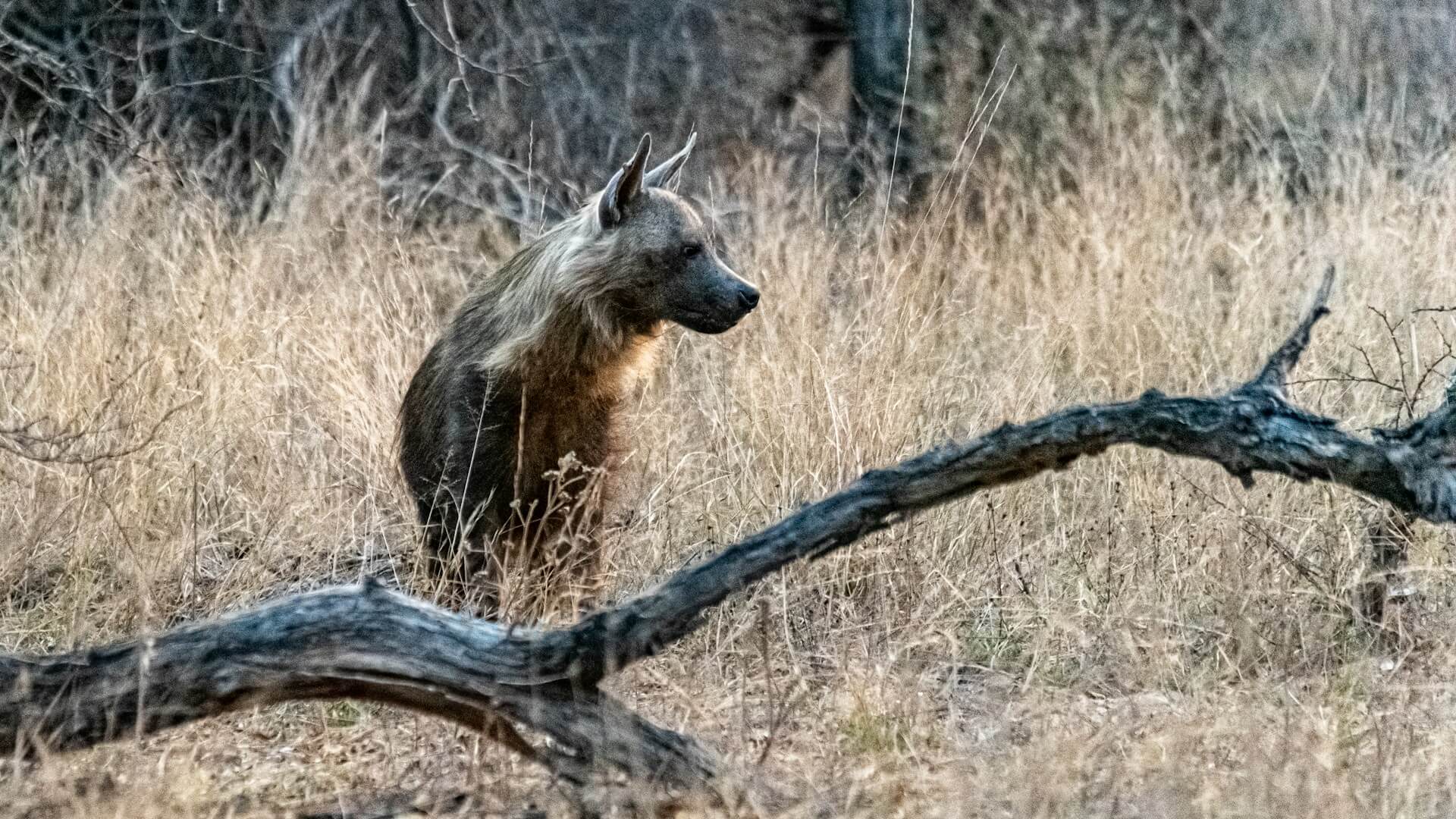
One beautiful winter’s day, we were sitting quietly in Pilanesberg National Park. The sky was vivid blue and the grass on the plains was a warm gold in the afternoon sun. Something caught my eye, but it was initially difficult to make out what it was. Then I couldn’t believe my eyes. A rack of ribs was nonchalantly bobbing across the plain. We remained still, trying to figure out what on earth was happening. Slowly, out of the long grass, a brown hyena emerged, complete with the ribs held high above its head. It was one of the more bizarre “sightings” I have had, and it won’t be forgotten anytime soon.
Spotted hyenas are not naturally found in the Pilanesberg National Park. There have been occasional sightings of one or two individuals, but they are not part of the park’s established wildlife. The park primarily focuses on brown hyena conservation. Brown hyenas, as a rule, are largely nocturnal. But in the Pilanesberg National Park, with spotted hyenas (which pose a large threat to the Browns) being rare, it is one of the best places to view brown hyenas during the day, especially in winter.
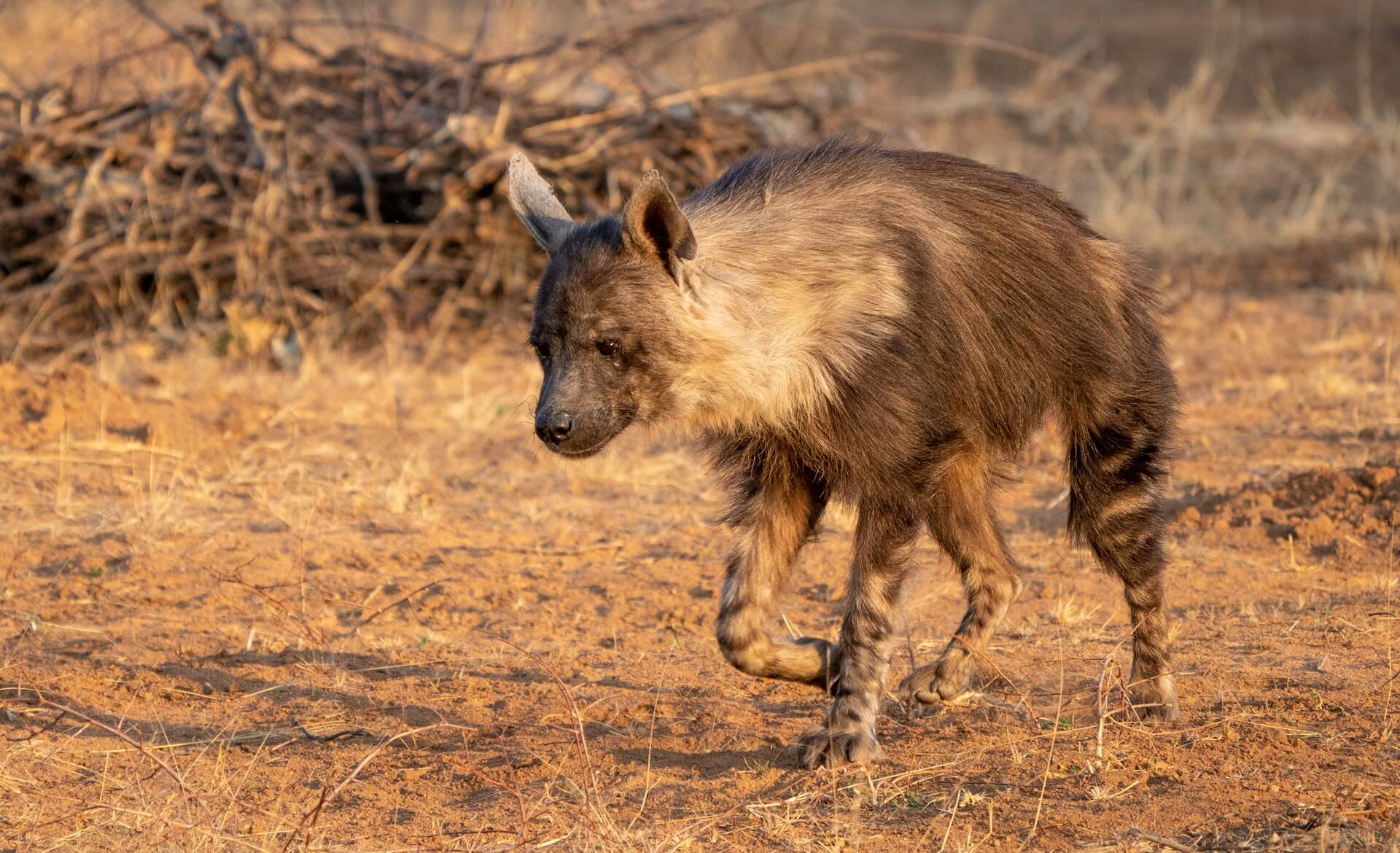
For many years, the brown hyena (Hyaena brunnea) was considered solitary. In 1984, a wonderful book, “Cry of the Kalahari”, was published by Mark and Delia Owens. They document their time living in the Kalahari Desert from 1974 to 1981. They were studying wildlife, specifically lions and brown hyenas, in a remote, uninhabited area called Deception Valley – a spot within the Central Kalahari Game Reserve of Botswana. For the first time, the brown hyena’s social structure was highlighted. They observed them living in family groups and made a surprising discovery: communal dens. Furthermore, they were found to have a collaborative approach to raising young, with mothers nursing each other’s cubs. This was the first time such behaviour had been observed. If you can get a copy of the book, it makes for a wonderful read if the subject interests you…
Known for its long (by comparison to a spotted hyena), pointed ears, shaggy, dark brown coat, long cream-colored mane, and striped legs, they are primarily scavengers, feeding on carrion, but also insects, bird eggs, wild fruits, and occasionally small prey. Whilst they live in clans, they typically forage for food alone. They will also kill smaller farm animals. Along Namibia’s Skeleton Coast, they are known as “strandwolves” (beach dogs/wolves), due to their scavenging of dead seals and pups. Interestingly, as seal density increases, brown hyenas become more efficient at hunting, with their capture rate increasing from 14% in November to 47% in January. They are performing a valuable service by cleaning up the beaches when they consume dead seals, and they also carry marine nutrients inland to their dens. If they find a particularly rich source of food (e.g. an ostrich nest with eggs), which they cannot eat at one sitting, they have been observed patiently removing helpings of the meal to caches scattered around the area, usually in thick vegetation or down holes for later consumption. Brown hyenas are well-adapted to arid environments and can survive with very little free-standing water by obtaining the water they need from their food (like, for example, tsamma melons).
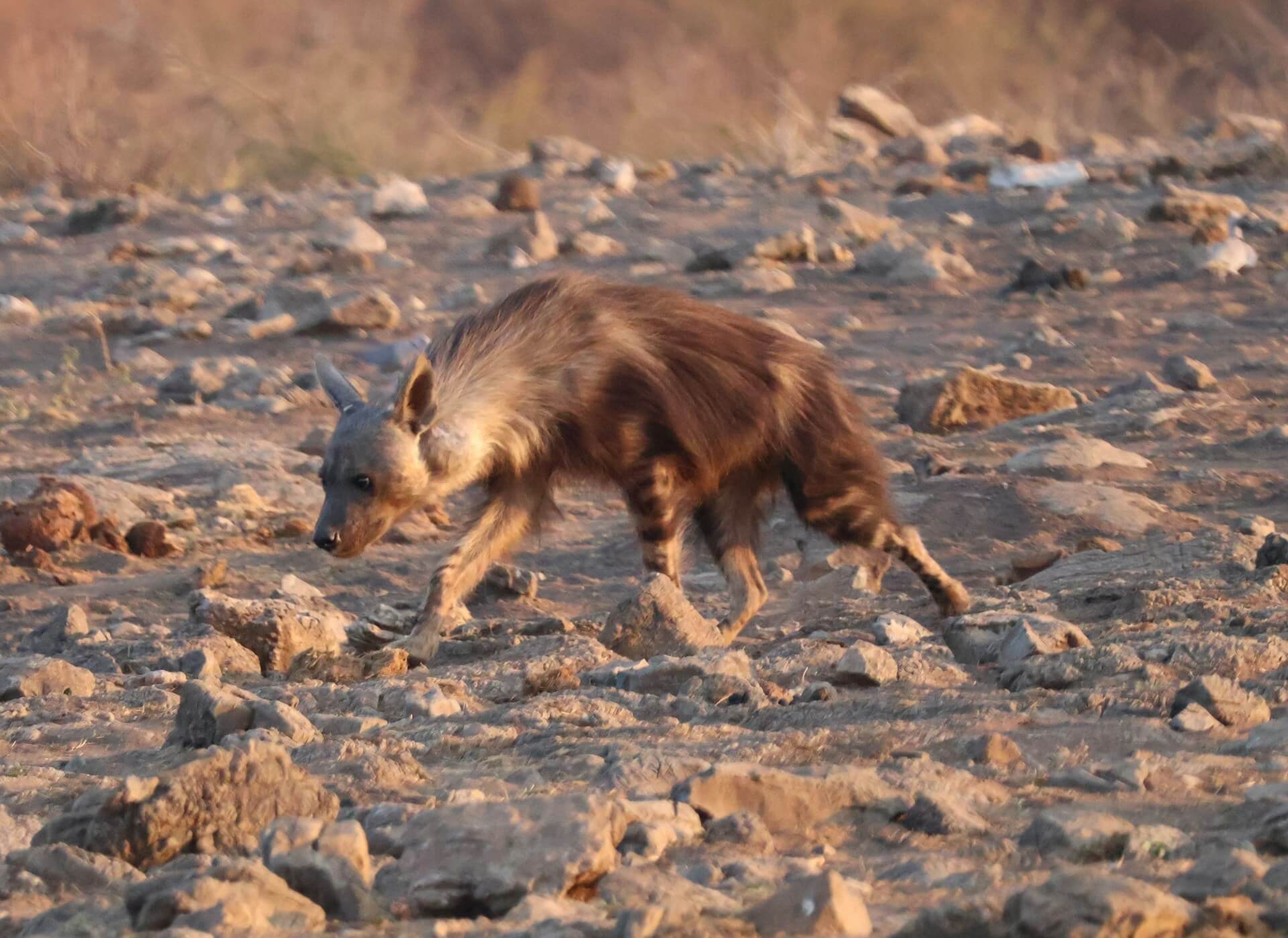
Brown hyenas live in small clans that defend territories and are known for their unique communication methods, including scent marking – which is one of the methods used to delineate territory. They typically have territories of between five and 500 square kilometres (dependent on how rich in resources the area is). Brown hyenas make use of middens (collections of dung), which are concentrated near territory boundaries. Their scat is a pale green / tan when fresh, turning white as it ages – because of the vast quantities of calcium within.
The scent marking, known as “pasting”, is an elaborate ritual where the hyena selects a single grass stem which it straddles and then marks. The finished mark has a blob of white paste about one centimetre long, and another centimetre long brown smear approximately one centimetre above the white paste. An interesting note from the book Wild Ways by Peter Apps observes that “in the Kalahari, they deposit an average of 2,6 pastings for every kilometre of nocturnal wandering. Each animal covers 30-40 km a night. So, if six animals share a territory, their combined efforts will stud their territory with 500 – 600 scent signals per night. They can be smelled by a hyena for at least a month, so the number of marks actively signalling that the residents are at home number 15 – 18 thousand!!”
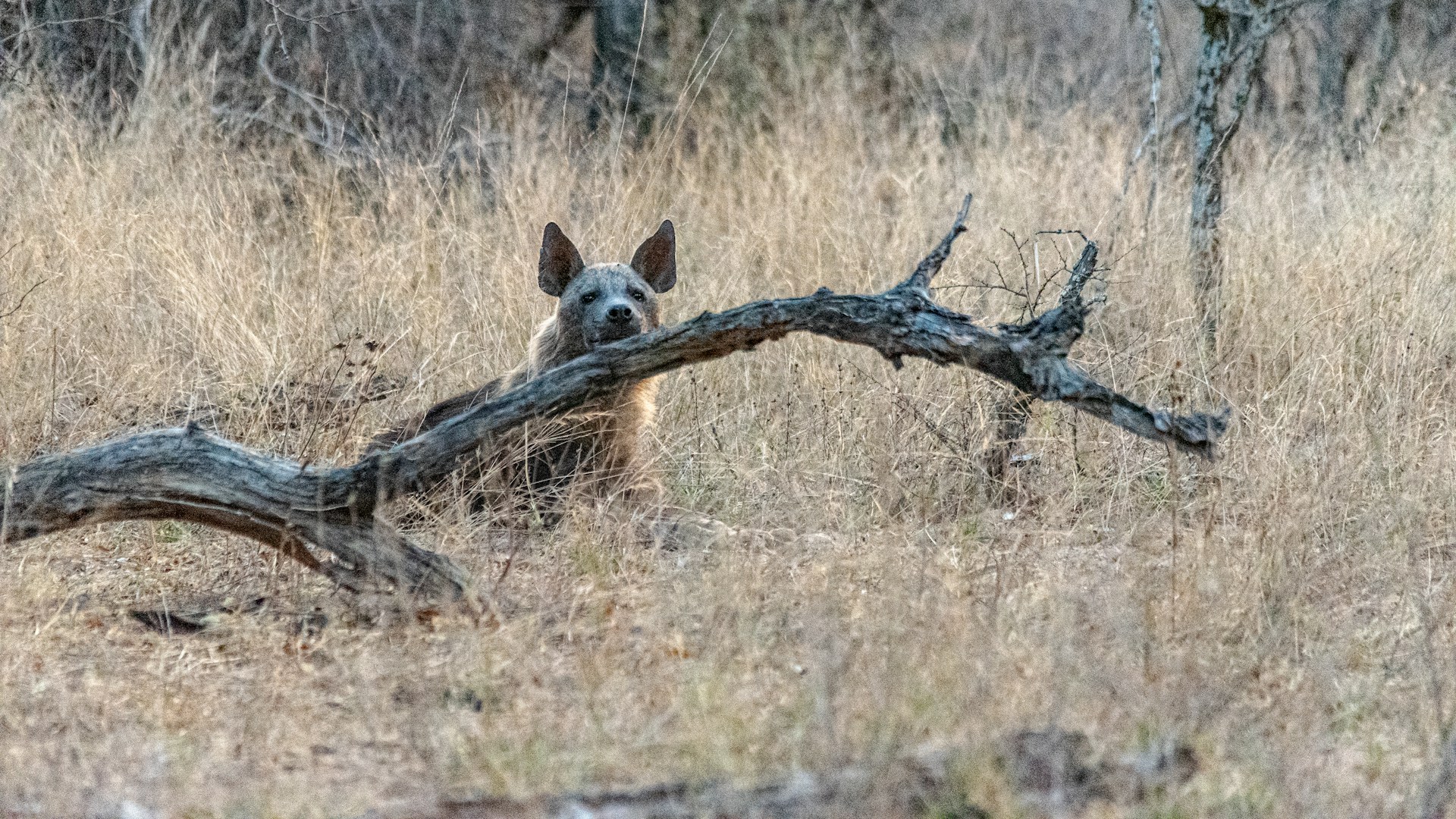
I’ve always considered brown hyenas rather small, but most sources concur that they stand about 80 cm at the shoulder and weigh somewhere around 40 kg. That’s significantly larger than, for example, a big border collie… The global population is estimated by IUCN at a number between 4,000 and 10,000 individuals, and its conservation status is marked as ‘near threatened’ on the IUCN Red List. It is a fascinating creature which, like so many others, faces significant threats, including human-wildlife conflict, habitat loss, and persecution for their body parts. They need our understanding and protection in order to continue to exist in the small niche they have created for themselves…
Jacqui Ikin & The Cross Country Team
INFO BLOCK:
Cry of the Kalahari – book:
https://www.amazon.co.za/Cry-Kalahari-Mark-Owens/dp/0395647800/