
Sultanahmet Square
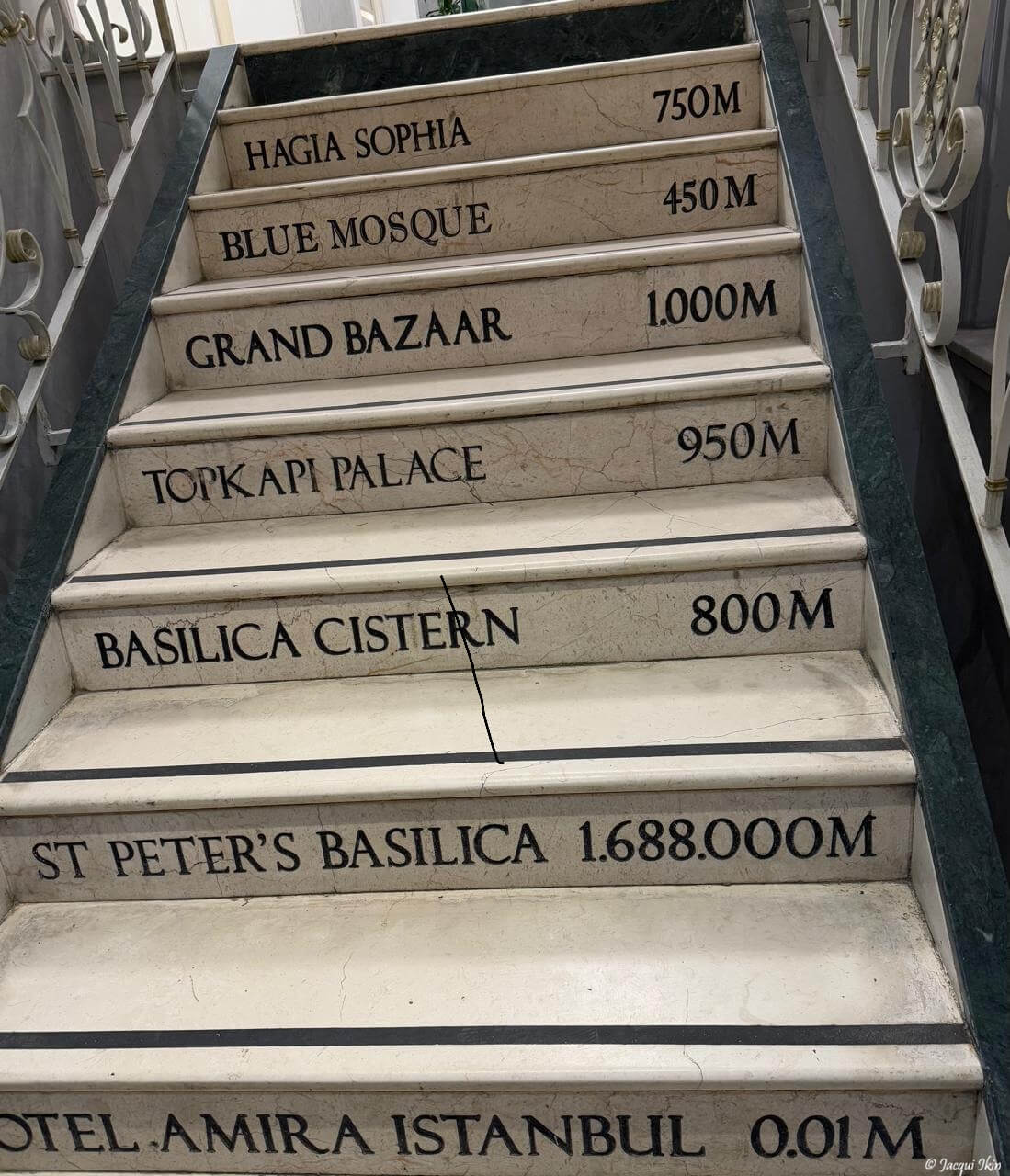
Hotel Amira Istanbul, where we stayed, was a mere 400 meters from Sultanahmet Square and thus an easy walk. Surrounded by the iconic landmarks of Hagia Sophia and Blue Mosque (both discussed in the previous two articles), the area is nevertheless rich with attractions of its own.
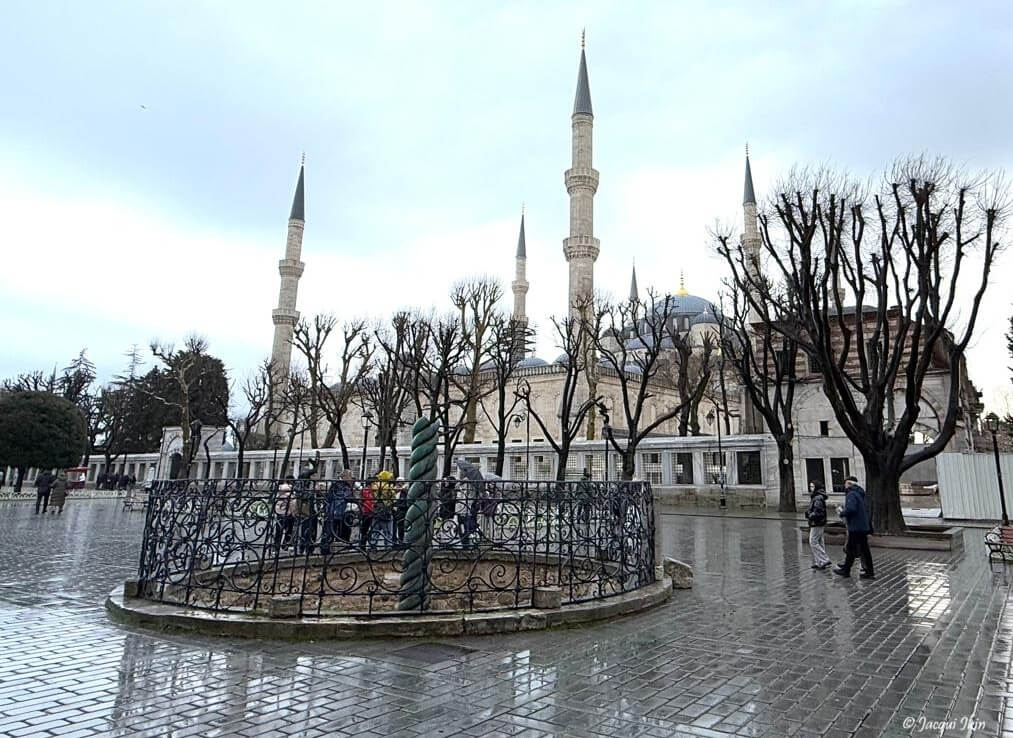
This image shows the Blue Mosque (Sultan Ahmed Mosque) and the adjacent Sultanahmet Square on a rainy day. The green monument within the circular fence is the ancient bronze Serpent Column, originally from Delphi and brought to Constantinople in the 4th century.
Sultanahmet Square is the historic heart of Istanbul. Originally constructed in 203 AD during the Roman period by Emperor Septimius Severus and later greatly expanded by Constantine the Great, the Hippodrome of Constantinople was a vast U-shaped arena capable of holding up to 100,000 spectators, serving as the social, political, and sporting heart of the Byzantine capital. The Hippodrome was originally designed for chariot races. It was also the stage for dramatic historical events such as the Nika Riots of 532 AD, while its central spine (spina) was adorned with monuments and spoils gathered from across the empire. Many of these monuments were looted or brought from ancient cities in Greece, Egypt, and Rome, transforming the arena into a living museum. Following the Ottoman conquest of Constantinople in 1453, the area became known as At Meydanı (“Horse Square”) and continued to function as the city’s principal ceremonial and public gathering space, hosting javelin games, imperial weddings, and grand sultanic festivals. Its significance was further reinforced in 1616 with the construction of the magnificent Sultan Ahmed Mosque, commonly known as the Blue Mosque, beside the square. Today, the historic site survives as a pedestrianized UNESCO World Heritage area where layers of Roman, Byzantine, and Ottoman history coexist in the heart of modern Istanbul.
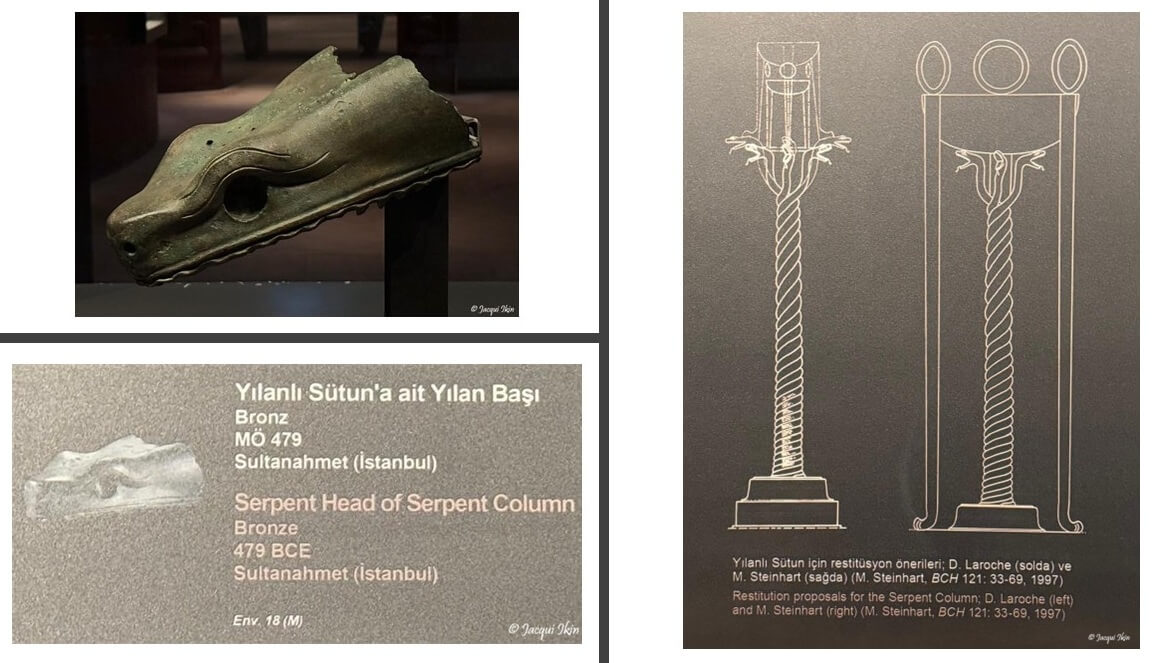
The one surviving serpent head is on display at the Istanbul Archaeological Museum.
The Serpent Column, also known as the Serpentine Column, Plataean Tripod or Delphi Tripod, is an ancient bronze column at the Hippodrome of Constantinople in what is now Istanbul, Turkey. The Serpent Column is a 2,500-year-old bronze monument brought from Delphi, Greece, by Emperor Constantine the Great in 324 AD. Originally created in 479 BC to celebrate the Greek city-states’ victory over Persia at the Battle of Plataea, it featured three intertwined serpents supporting a golden tripod. Cast from melted-down bronze weapons taken from the Persians, the column was dedicated to Apollo at the Sanctuary of Delphi as a thank-offering. The column consists of three intertwined snakes with their heads originally spreading out to support the golden tripod, which was likely stolen in the 4th century BC. It represented 31 Greek cities that fought against Persia; its inscription lists these cities. Emperor Constantine the Great brought the column to his new capital, Constantinople, in the 4th century to cement its status as the new centre of the world. The heads of the serpents remained intact until the 17th or 18th century, disappearing after the Ottoman conquest, with one surviving head on display at the Istanbul Archaeological Museum. During the Ottoman period, the column was considered a protective talisman against snakes, scorpions, and pests. Today, the bronze, worm-like pillar survives, damaged and truncated, within the Sultanahmet Square area, serving as one of the oldest and most significant ancient artifacts in Istanbul.
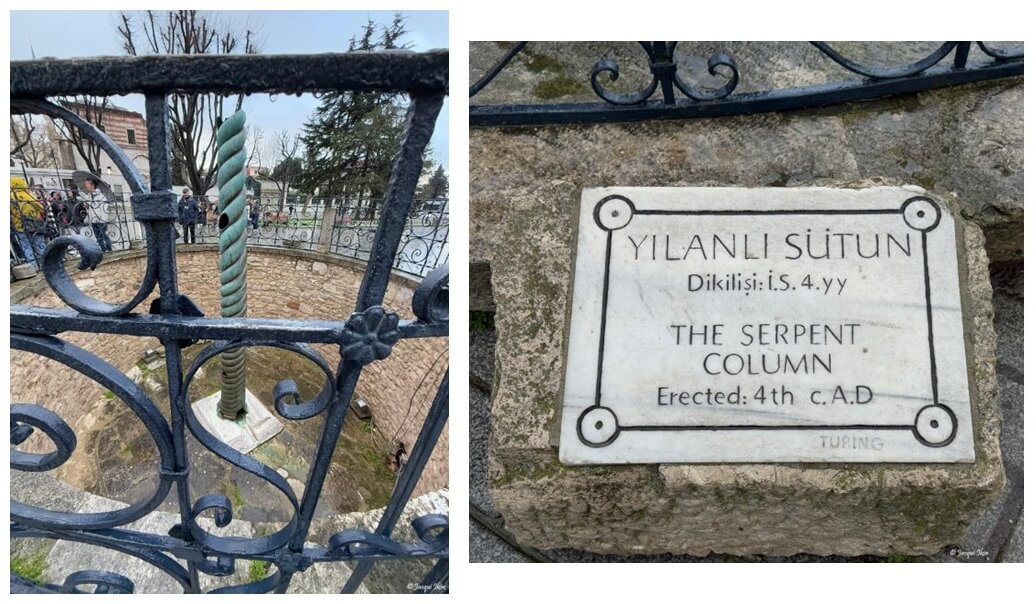
The Serpent Column in the Sultanahmet Square area.
Rising above Sultanahmet Square with an air of timeless authority, the Obelisk of Theodosius is one of the oldest surviving monuments in Istanbul and a remarkable link between the worlds of ancient Egypt, Rome, and Byzantium. Originally commissioned by Pharaoh Thutmose III in the 15th century BC for the great Temple of Karnak at Luxor, the towering monolith of pink Aswan granite was transported to Constantinople in 390 AD under the orders of Roman Emperor Theodosius I – an astonishing engineering achievement for the era. Its four polished faces remain covered in finely carved Egyptian hieroglyphs celebrating the military triumphs of Thutmose III, while the elegant Byzantine marble pedestal beneath tells a different story altogether: through intricate bas-reliefs, it depicts the imperial court, scenes of public ceremony, and even the dramatic transportation and raising of the obelisk itself. Standing today on the site of the ancient Hippodrome, the monument embodies the layered civilizations that have shaped the city across more than three millennia.
The Obelisk of Theodosius
At the northern end of the ancient Hippodrome / Sultanahmet Square, opposite the Blue Mosque, stands the elegant German Fountain (Alman Çeşmesi), one of Istanbul’s more unexpected yet charming monuments. Officially inaugurated in 1901 to commemorate the second anniversary of German Emperor Wilhelm II’s visit to the city, the fountain was an extraordinary feat of international craftsmanship: constructed entirely in Germany, then painstakingly transported to Istanbul piece by piece for reassembly. Designed in a graceful Neo-Byzantine style, the octagonal gazebo-like structure is crowned by a domed roof supported by eight marble columns, blending European imperial symbolism with architectural elements that echo the city’s Byzantine heritage. Amid the bustle of Sultanahmet Square, the fountain remains both a historical curiosity and a quiet reminder of the diplomatic ties once forged between the German and Ottoman Empires.
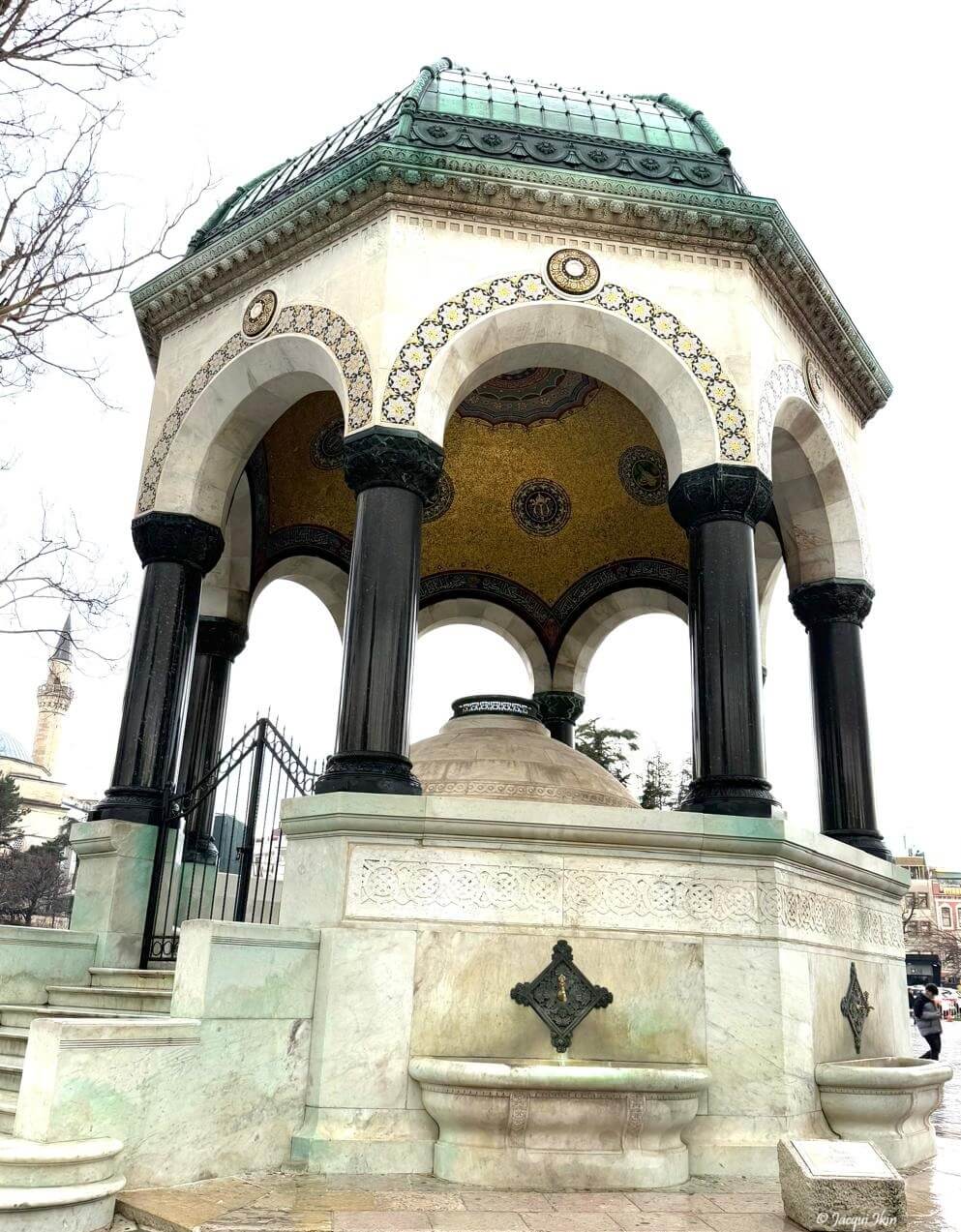
The elegant German Fountain (Alman Çeşmesi).
To be honest, I am not all that keen on shopping as an activity. In fact, if I could wave a magic wand, and the required goods could land in my lap, that would be a first-class solution for me. However, one cannot go to Istanbul without going to the mother of all shopping experiences. Few places capture the energy, colour, and layered history of Istanbul quite like the Grand Bazaar, one of the oldest and largest covered markets in the world.
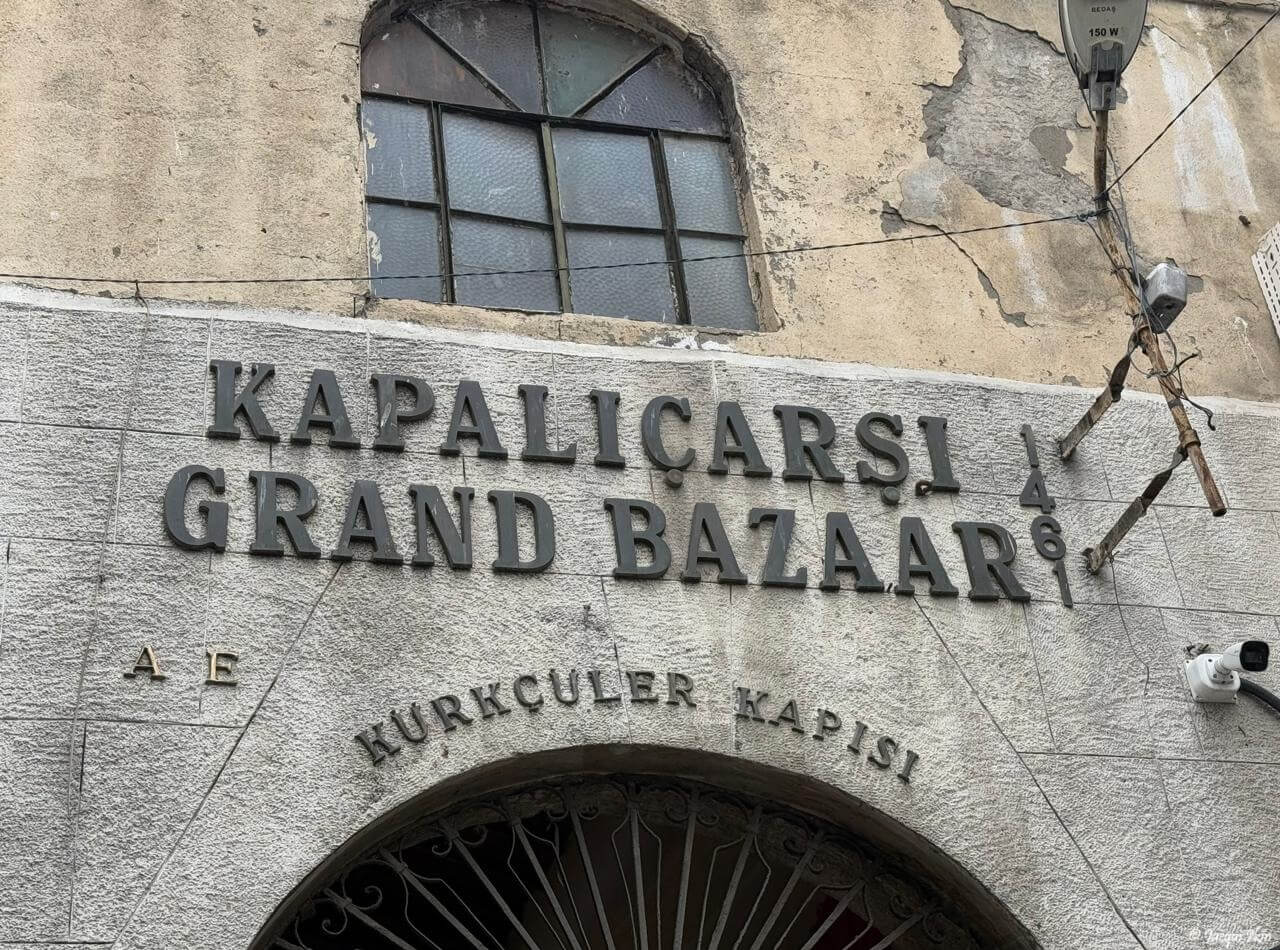
One of the entrances to the Grand Bazaar.
Established shortly after the Ottoman conquest of Constantinople in the 15th century under Sultan Mehmed II, the sprawling labyrinth of vaulted passageways gradually evolved into a commercial heart of the empire, where merchants from Europe, Asia, and the Middle East traded silk, spices, jewellery, carpets, ceramics, and precious metals.
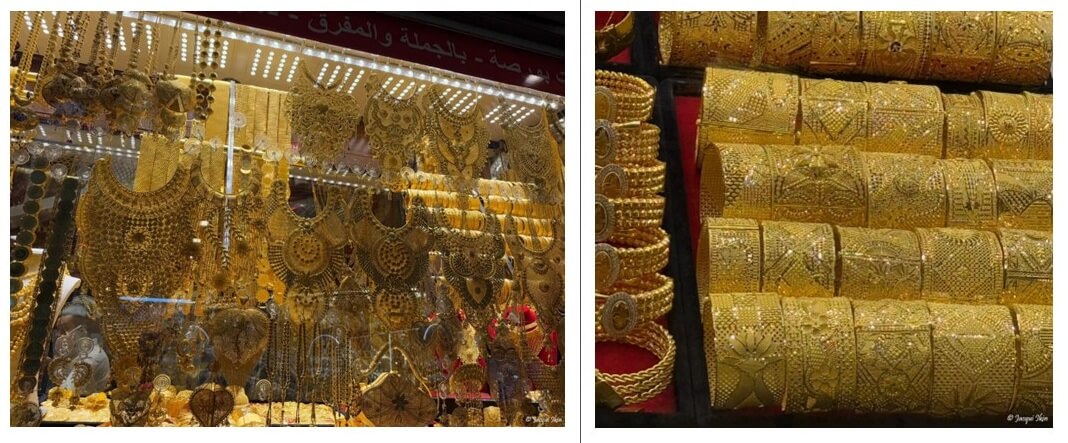
Gold, gold everywhere…
Today, beneath its painted domes and arched ceilings, thousands of shops continue this centuries-old tradition, creating an atmosphere that is at once theatrical and deeply historic. The Grand Bazaar is more than merely a marketplace; it is a living monument to Istanbul’s role as a crossroads of civilizations, where the echoes of caravans, traders, and travellers still seem to linger within its bustling corridors.
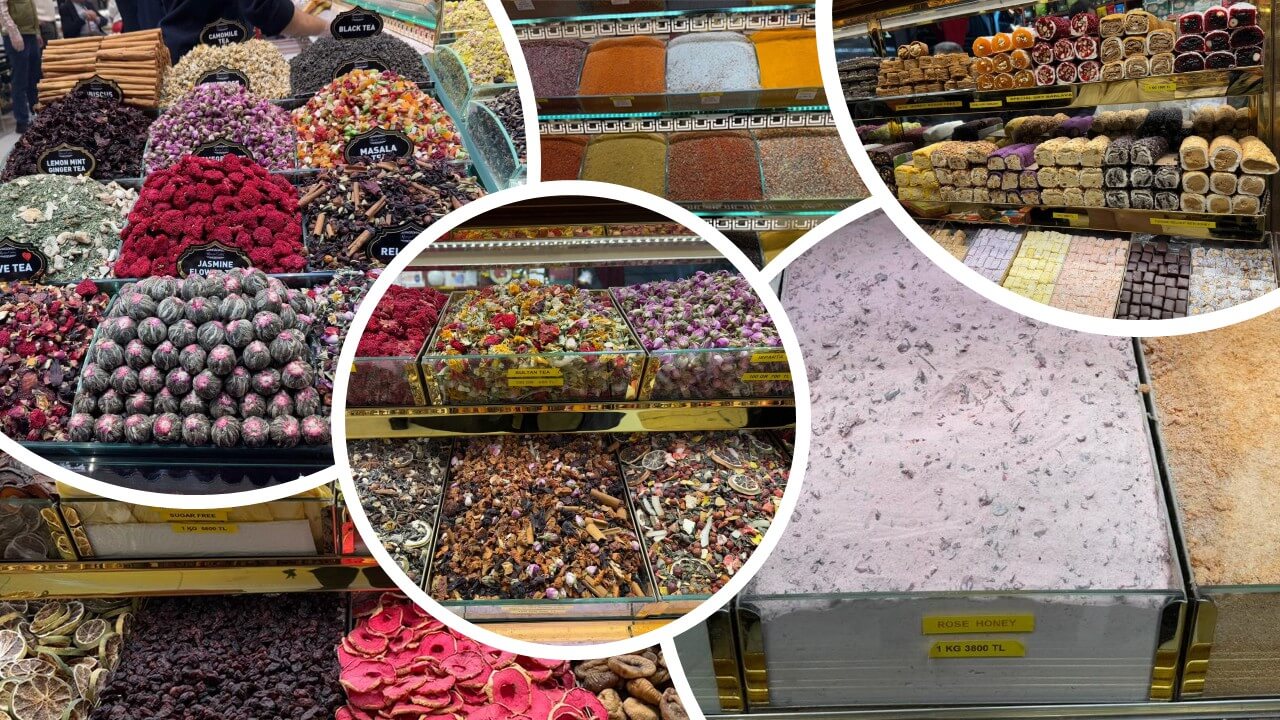
Spices, teas, sweets, dried fruits – you name it, you can purchase it in the Grand Bazaar!
Back on the square, we were in need of sustenance. We were in luck and came across vendors selling two comfort foods. Roasted chestnuts (something I have always wanted to try), known locally as kestane, are sold from glowing charcoal-heated carts whose warmth becomes especially inviting during the cool autumn and winter months, filling the air with a rich, earthy fragrance. To be honest, they were somewhat underwhelming, but pleasant none-the-less, with a starchy, subtly sweet, and buttery flavour (below right).
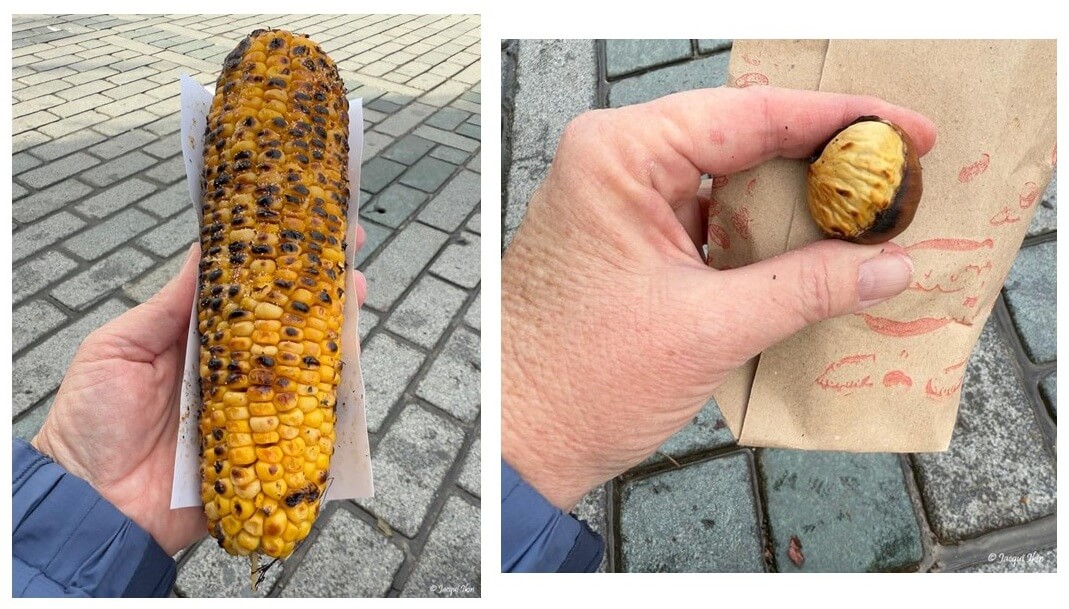
The second was sweetcorn – mısır – cooked over hot coals and lightly seasoned with salt and spices (left in image above) . The secret, however, lay in the method: the vendor first boiled the corn to retain its tenderness and juiciness, before finishing it over the grill to impart a rich, smoky flavour. The result was utterly delicious – succulent kernels infused with the unmistakable taste of charcoal. It is a technique we could certainly learn from and happily replicate here in sunny South Africa. Simple yet deeply evocative, these humble street snacks form part of the sensory fabric of Istanbul itself, offering both nourishment and nostalgia.
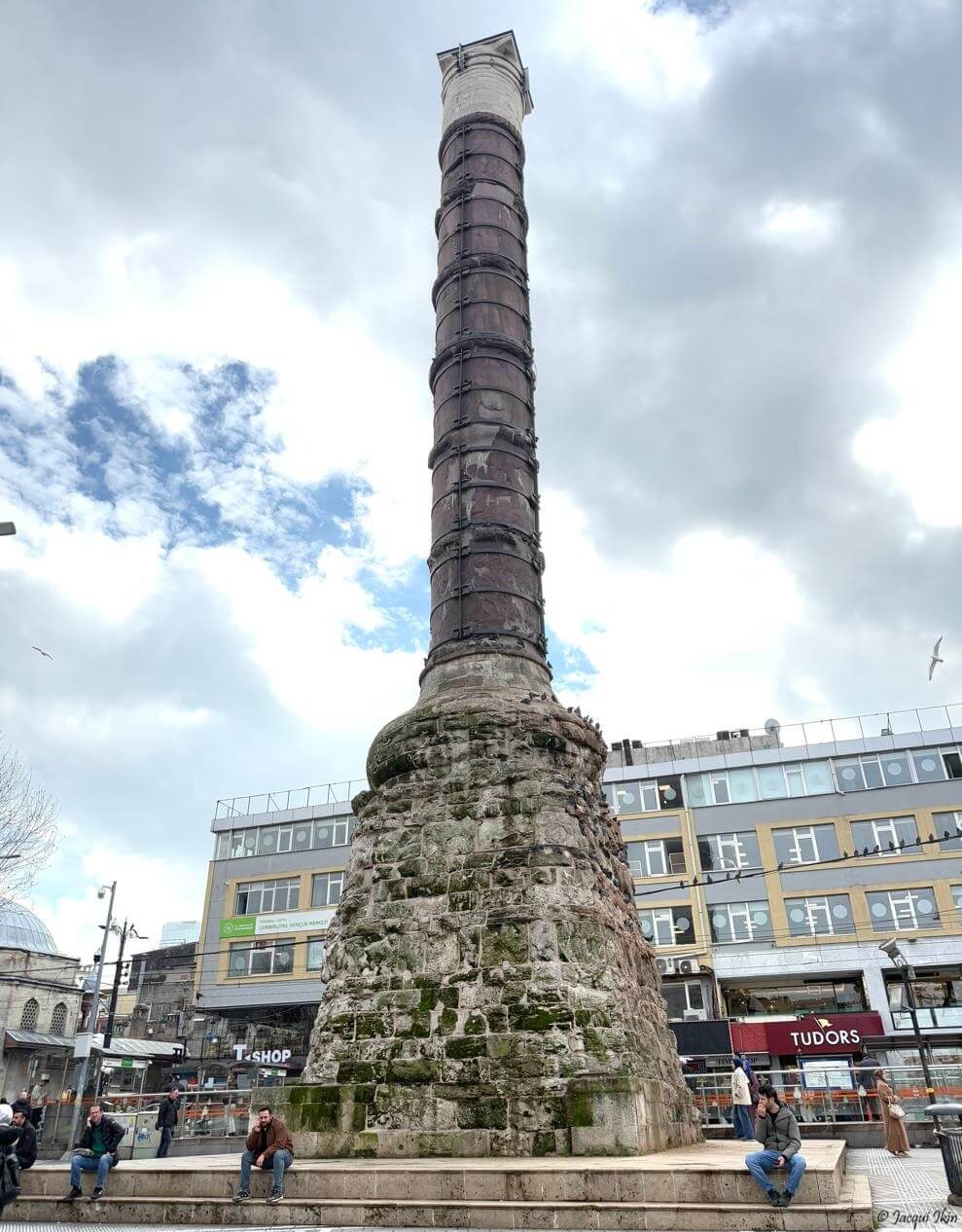
The Column of Constantine. Eventually, I get sick of figuring everything out. But something in my mind also never wants to miss out on anything. So, I take “happy snaps” as I walk and figure it all out later. This was one of those…
Standing on the second hill of Istanbul in the historic Fatih district, a short walk from both Sultanahmet Square and the Grand Bazaar, the Column of Constantine – also known as the “Hooped Stone,” and more evocatively as the “Burnt Column” – remains one of the city’s most enduring Roman monuments. Erected by Emperor Constantine the Great on 11 May 330 AD to commemorate the dedication of his new imperial capital, “New Rome,” later called Constantinople, the towering column originally soared to nearly 50 metres and was crowned by a colossal statue of Constantine portrayed as the sun god Apollo. Centuries of fires, earthquakes, and natural decay gradually weakened the structure, necessitating the addition of iron reinforcing bands that gave rise to its Turkish name, meaning “hooped stone.” Following the catastrophic fire of 1779, which blackened both the monument and the surrounding quarter, the column acquired its darker sobriquet, the “Burnt Column,” and underwent restoration, including the masonry pedestal still visible today. Tradition further enriches the monument’s mystique, claiming that a hidden chapel within its base once housed sacred relics tied to early Christian history, lending the weathered structure both imperial grandeur and spiritual resonance.
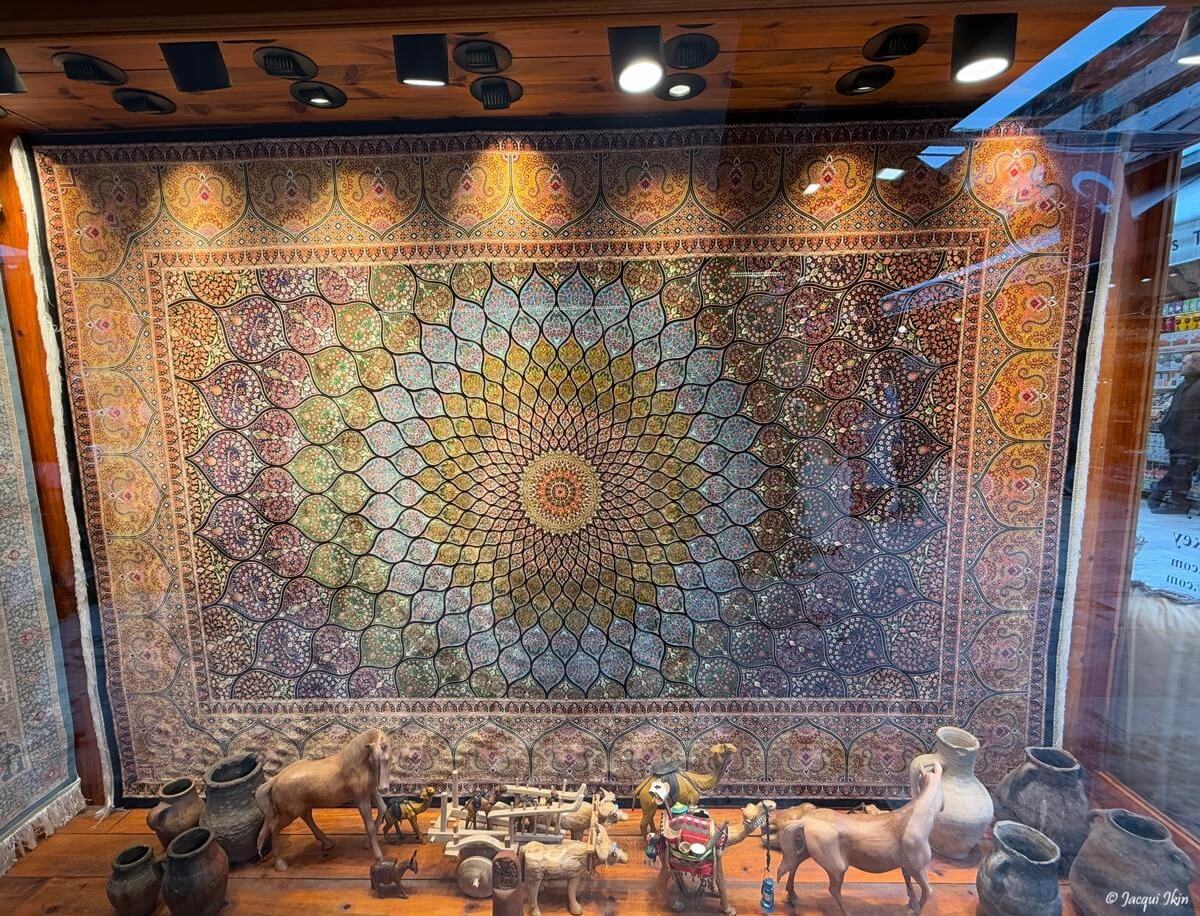
And finally, the Turkish Rug.
On our last walk back to the hotel, we came across this stunning rug in a shop window. A handmade Turkish carpet takes anywhere from two months to several years to complete. The exact timeline relies heavily on the carpet’s dimensions, the knot density (knots per square inch), and the thread material (wool, cotton, or silk). I have no idea of the cost of this spectacular specimen, but I know that it would definitely fall into my “break the bank” category!! I could, however, absolutely see it in my lounge… Perhaps on a wall rather than on the floor!
Well, that covers Istanbul. I hope you have enjoyed the articles and learned a little about this intriguing city. Next week we begin a series on the Natal Midlands – in time to prepare for coastward-bound trips for the July school holidays…
Jacqui Ikin & The Cross Country Team
