
Meet the Southern Yellow-Billed Hornbill: The “Flying Banana” of Southern Africa

Well, December is here. With it comes the inevitable tradition of trekking somewhere interesting for the holidays. Or perhaps this year you’ve decided to simply remain at home and savour the quiet. Either way, there’s a distinct possibility that you may cross paths with the country’s beloved “Flying Banana” — the southern yellow-billed hornbill (Tockus leucomelas).
This charismatic bird, with its oversized banana-yellow bill, jaunty swagger, and endlessly curious personality, has become as much a part of the holiday wilderness experience as dust on your boots and a cooler full of cold drinks. With its expressive mannerisms and delightfully exaggerated features, the hornbill is one of those creatures that makes even seasoned safari-goers reach for their cameras.
But it isn’t only in the bushveld that these birds appear. Yellow-billed hornbills favour the drier savannas, woodlands, and thornveld of inland South Africa, and they are increasingly adapting to suburban life. In and around Gauteng — particularly in neighbourhoods such as Blairgowrie, Linden, Waterkloof Ridge, Westdene, and the Kyalami / Glenferness area — sightings have become more common.
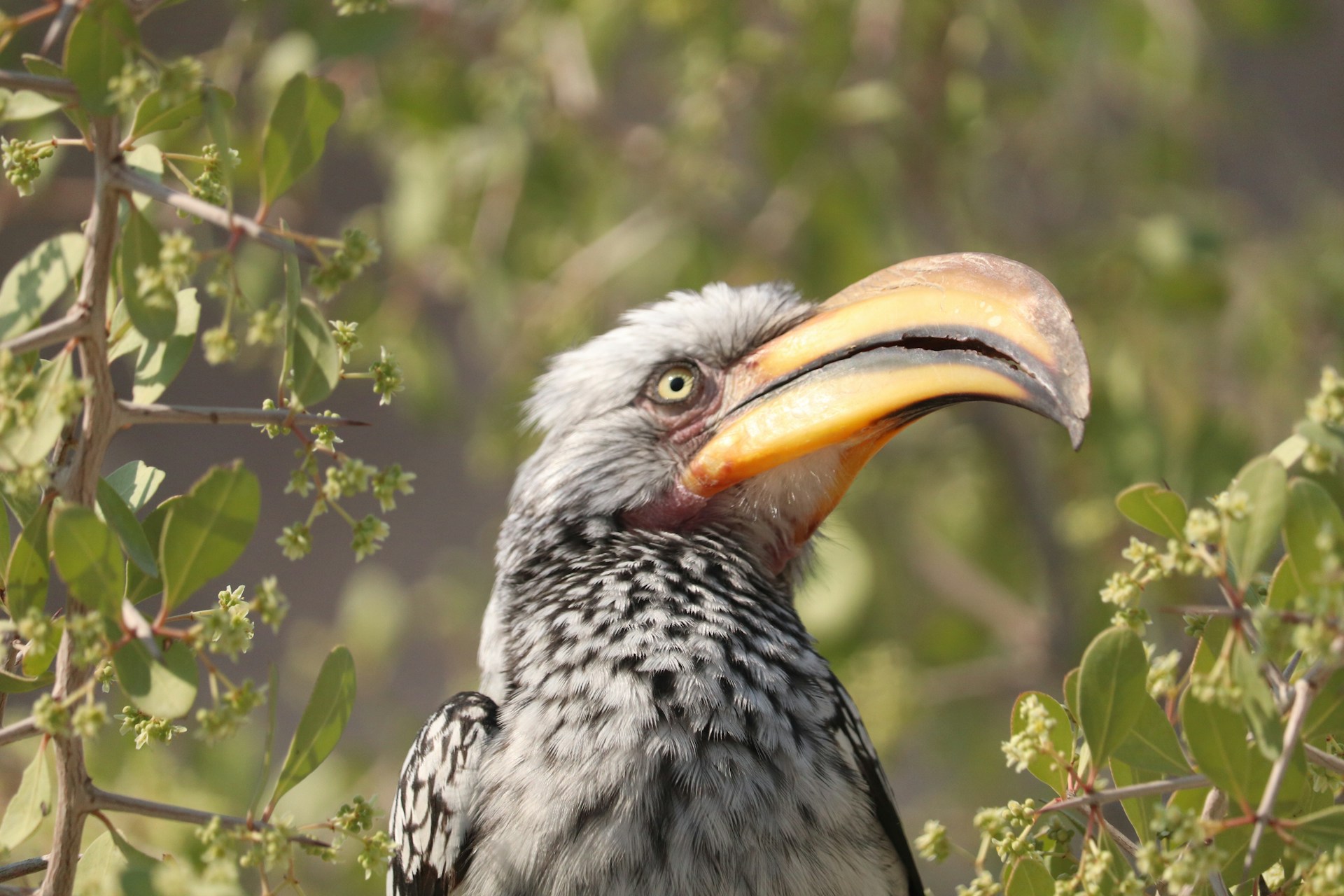
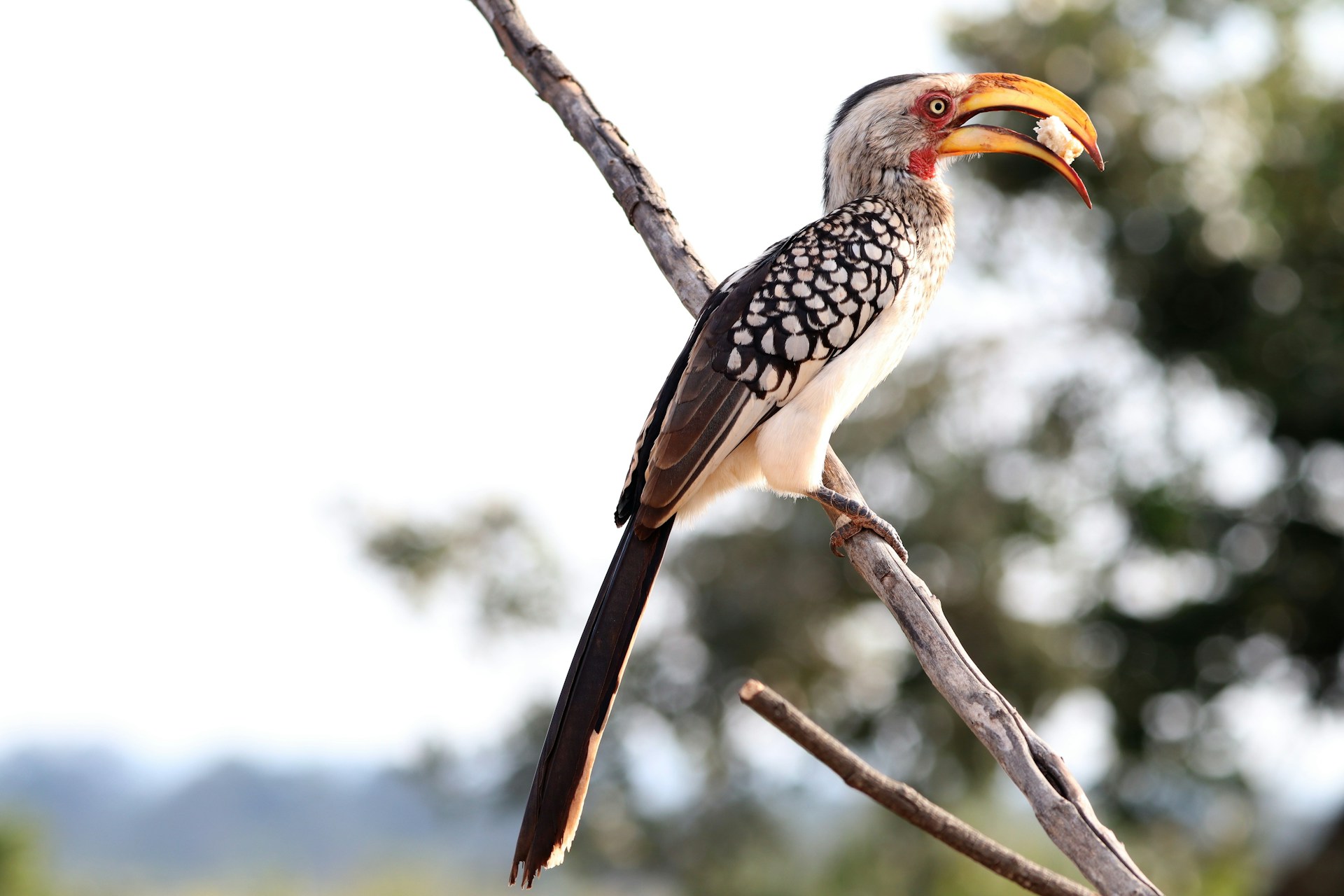
The southern yellow-billed hornbill is instantly recognizable. Its bright banana-yellow beak curves downward in a dramatic arc, contrasting with its white belly, grey neck, and striking black-and-white wings. Males have longer bills and a more pronounced casque on the upper mandible, while females are slightly smaller and slimmer-faced. They’re sociable birds, too. You’ll often see pairs or small family groups perched on branches, rocking, bowing, and clucking loudly — behaviours that look uncannily like animated conversation.
Although capable fliers, hornbills spend much of their day on the ground, foraging for anything worth eating. And their diet is impressively varied. They’ll happily snap up termites, beetles, grasshoppers, caterpillars, spiders, scorpions, the occasional centipede, small vertebrates like frogs or even bird chicks, as well as seeds, berries, nuts, and fruit. Many years ago, I remember accidently dropping a box of Woolworths’ strawberry and yoghurt cereal in Manyane Camp at Pilanesberg… It created an instant feeding frenzy, with the yellow-billed hornbills leading the charge!
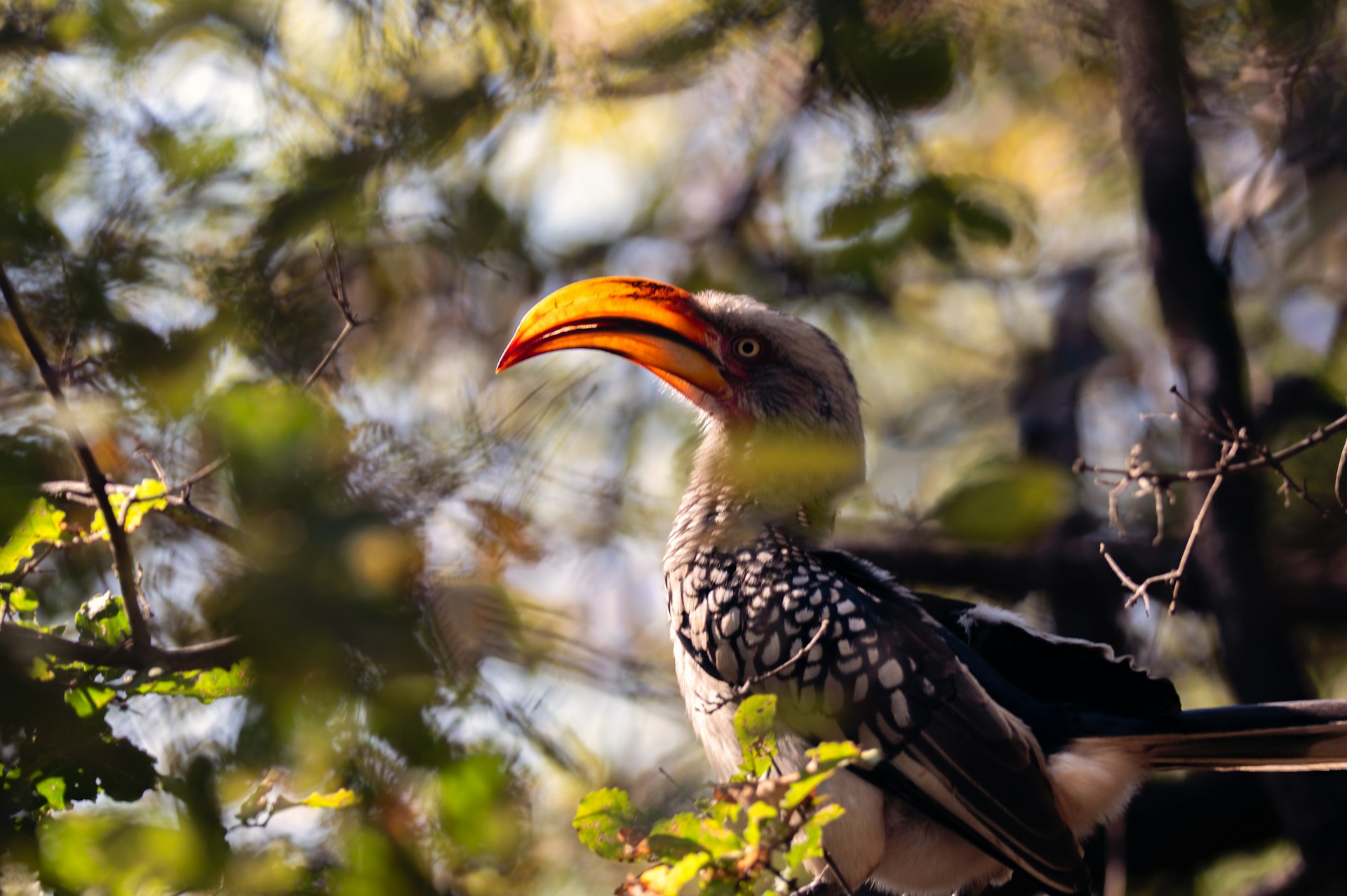
They use their oversized bill like a pair of precision forceps — picking up food, tossing it back, and swallowing it with the help of a short, stubby tongue. One of the most delightful behaviours to witness is their cooperative foraging with dwarf mongooses. While the mongooses dig for insects, the hornbills stand guard, scanning for danger and warning the mongooses of aerial predators such as raptors; in return, they enjoy an easy buffet of exposed prey. It’s a beautiful example of symbiosis in action — a mutually beneficial strategy for both food and safety. This partnership is so well established that mongooses often wait for the hornbills, or are even woken by them, before beginning their foraging day. There have also been records of hornbills waiting expectantly at mongoose burrows, eager for the foraging to begin. One of the coolest videos I have ever seen is a little dwarf mongoose playing dead for a yellow-billed hornbill (see info block).
These birds have a remarkable nesting strategy. Hornbill breeding season aligns with the rainy summer months, typically starting with the first rains in September, with egg-laying peaking from October to December, coinciding with peak rainfall in Southern Africa. Courtship involves mutual preening and an endearing feeding ritual: for weeks, the male brings the female small offerings of food to strengthen their bond. The pair then selects a natural cavity — often an old woodpecker or barbet nest — and lines it with bark and leaves. And here’s where things get truly fascinating. Once inside, the female seals the entrance with a wall made of her droppings and food remains, leaving only a narrow vertical slit. Through this tiny opening, the male delivers all her food while she incubates the clutch of 2 – 6 white eggs. During this period, she undergoes a complete moult of her flight and tail feathers — something she can only do safely while sealed inside the nest. When the chicks are half-grown, the female breaks out to help the male gather food. The chicks then reseal the entrance themselves, maintaining the protective barrier until they’re fully feathered and ready to burst into the world.
The nests of the southern yellow-billed hornbill also typically incorporate a long, vertical escape tunnel — a unique architectural feature that serves as a vital defence mechanism. While the main entrance is sealed with a mixture of mud, droppings, and food remains to protect the female and chicks during nesting, the escape tunnel offers a hidden emergency exit if a predator, such as a snake or monitor lizard, breaches the main cavity. Should this occur, the female and chicks can quickly move into the separate tunnel, hiding from immediate danger or even fleeing the nest entirely. Some nests also include a “chimney” within the cavity specifically for this purpose, highlighting the remarkable ingenuity of these birds in safeguarding their young.
Their flight is powerful but often brief — rapid wingbeats followed by short glides. Interestingly, they lack certain underwing coverts, a feature that enhances airflow while flying. These hornbills are a sociable species, generally living in small groups. They have a very distinctive clucking call. Once one bird starts calling, the whole group will often join in, creating a cacophony of sound. In the bushveld you will often see two hornbills sitting together, clucking away with very entertaining wings open, back and forth rocking, head bowing display.
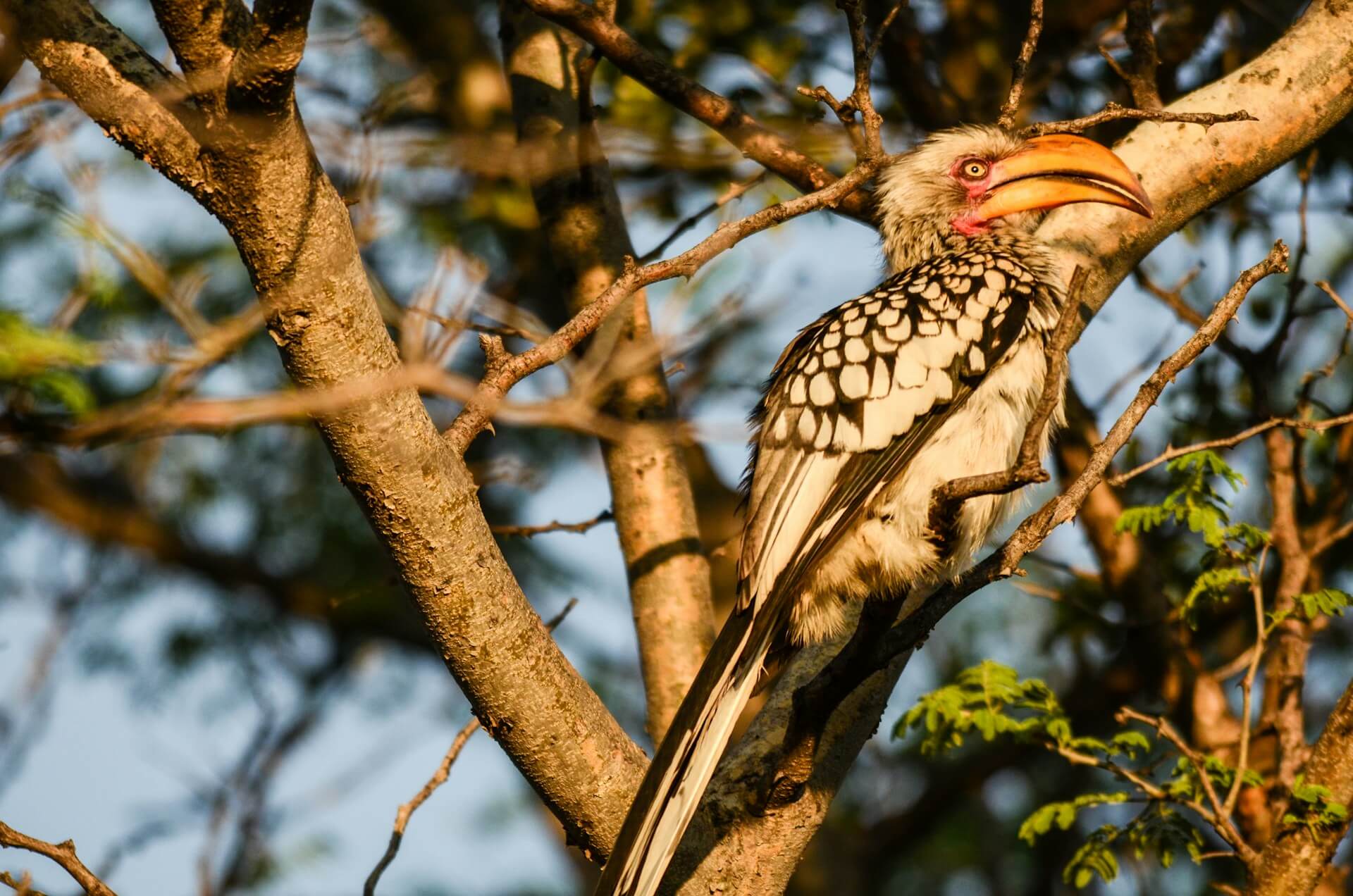
Across various African cultures, hornbills are often viewed as symbols of strength, wisdom, and spirituality. They are sometimes seen as messengers between the living and the spirit world and are associated with rain, protection, and good fortune. The Zulu people call the yellow-billed hornbill “Umkolwana”, meaning “Little believer”, due to the bird’s tendency to constantly look upward towards the sky. The bird is a symbol of faith and belief in a better tomorrow.
The southern yellow-billed hornbill is one of Africa’s most delightful birds to observe. Their bold personalities, unique breeding habits, and striking appearance make them a highlight of any safari — and a reminder that sometimes the most common animals are also the most captivating. Keep an eye out for the “Flying Banana” this holiday season — whether strutting through the savanna or popping up in your backyard. With its bold bill, curious antics, and cheeky personality, the southern yellow-billed hornbill is a tiny reminder that the wild is never far away — and always full of surprises.
Jacqui Ikin & The Cross Country Team
INFO BOX:
Southern Yellow billed Hornbill (Tockus leucomelas):
https://www.facebook.com/watch/?v=378207805376181
Southern Yellow-billed Hornbill call:
https://www.tiktok.com/@mbazo.safari.lodge/video/7483840382028074295
Hilarious dwarf mongoose plays dead for hornbill!
https://www.youtube.com/watch?v=yFAHwRqLOJ8&t=1s