
The undertaker and Marilyn Monroe
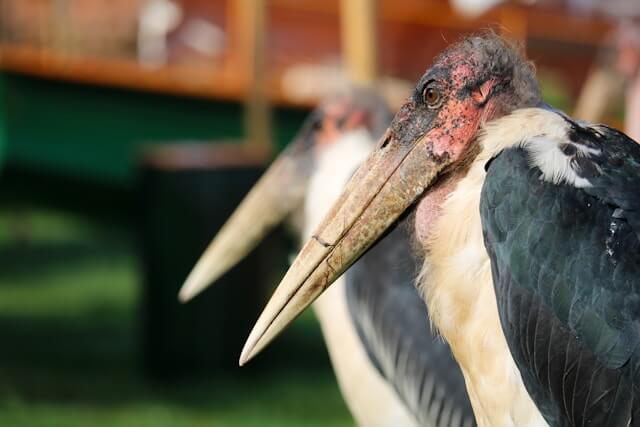
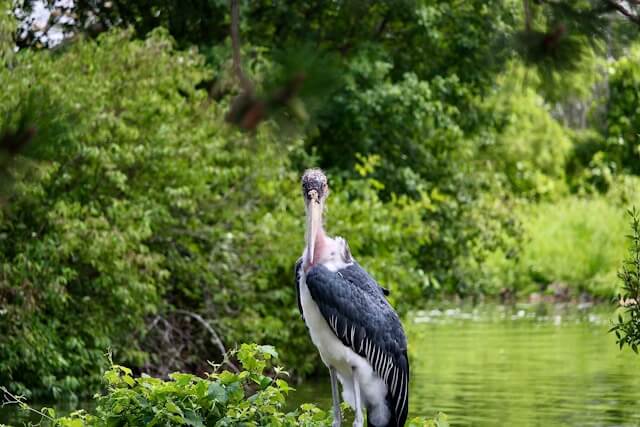
The marabou stork (Leptoptilos crumenifer) is not something that I have ever seen in huge numbers… Until Chobe. On the Chobe flood plains, they gather in huge flocks. The also decorate the many large dead trees, perching like macabre candle sticks on the bare, grey branches. Interestingly, unlike most storks, the marabou stork flies with its neck retracted like a heron. In the air, they are amazingly elegant and graceful. But once on the ground, and looking at them close-up, they are considered one of the “ugly five” …
They are large birds, reaching a height of 152 centimetres and a weight of 9 kg. Traditionally, the wandering albatross or the Andean condor, are accepted as the birds with the largest wingspan. However, the marabou stork is very close in size. A wingspan of 3.7 m was accepted by Fisher and Peterson, who ranked the species as having the largest wingspread of any living bird. Even higher measurements of up to 4.06 m have been reported, although no measurement over 3.20 m has been verified. More typically, however, these storks measure 225–287 cm across the wings.
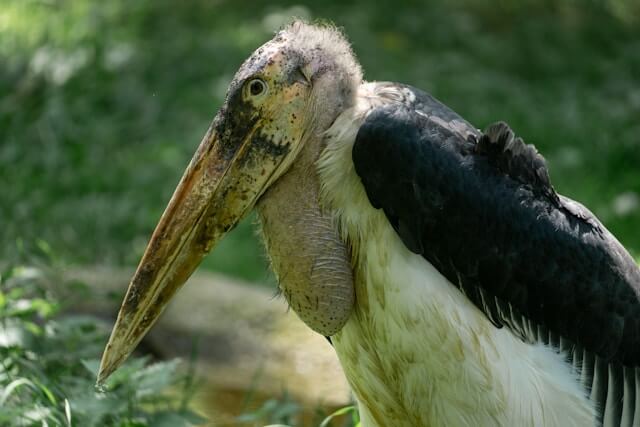
The origin of its name? Leptoptilos hails from the Greek “leptos”, which translates to ‘delicate, elongated’ and “ptilon” which refers to ‘feather’, which refer to the lightness of its feathers. Crumenifer comes from “crumena” which was a leather bag for money that was carried in the old times (and was worn around the neck) and from the Latin “fero”, meaning ‘to carry’. Which obviously refers to the huge pink gular sac at its throat…
The marabou is sociable, and generally breeds in colonies. Despite being gregarious by nature, they can be awfully ill tempered. Like most storks, they are not terribly vocal, but they do indulge in bill-rattling courtship displays… The Marabou stork’s long, pink pouch hanging from its neck is used in mating rituals. The 18-inch inflatable pink sac (which is devoid of feathers) is particularly obvious during the breeding season. It connects directly to the left nostril and acts as a resonator, allowing the bird to produce a guttural croak. It breeds in the dry season, building a tree nest, on which two or three eggs are laid. The eggs hatch after an incubation period of 30 days, and the young only reach sexual maturity at four years of age. In the wild, they usually live about 25 years…
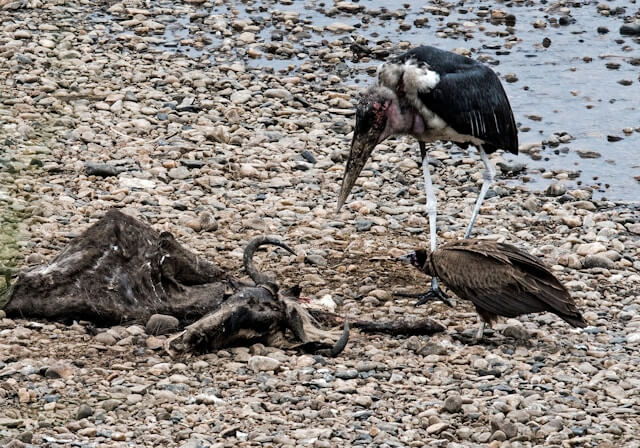
What do these birds eat? Well, everything and anything that remains still long enough and that it is capable of swallowing… From other birds’ chicks, fish, frogs, insects, eggs, small mammals, lizards, snakes and even crocodile hatchlings. They frequently scavenge – and the naked head and long neck are adaptations to this livelihood (as with vultures). A fully feathered head would become very dirty with the carcass remains, and a bare head is easier to keep clean. Strangely, as they are known to regularly eat putrid and seemingly inedible foods, they sometimes wash food in water to remove soil. They frequently follow vultures, which are better equipped with hooked bills for tearing through the tough skin of some carcasses. They will wait for the vultures to finish and then only move in to feed. They perform an important natural function of cleaning up by eating the carrion and waste, thereby helping avoid the spreading of pathogens. When there is a fire in the wild, they march in front of the advancing fire, grabbing small animals that are fleeing.
Sadly, many marabous have become dependent on human garbage. Hundreds of the huge birds can be found around dumps or waiting for food in urban areas. Marabous that are eating human garbage have been seen to eat almost anything they can swallow, including shoes and pieces of metal. Those that are conditioned to eat from human sources have been known to lash out when people refuse to give them the food.
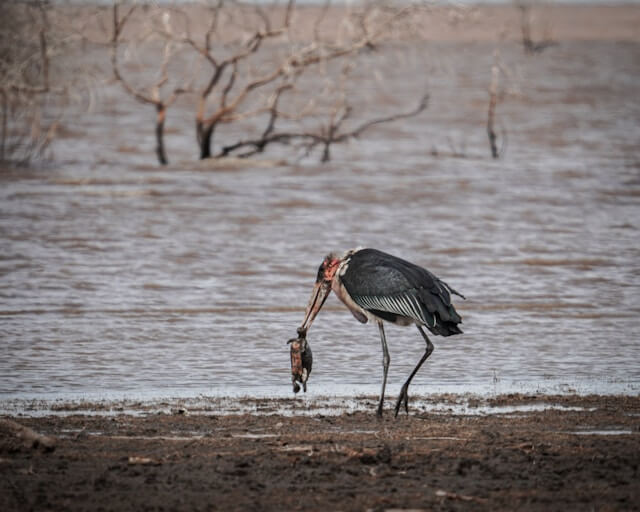
Fully grown marabou storks have few natural enemies, and their survival rate is high. Lions do occasionally manage to catch them, but they can hardly be considered a favourite. A number of endoparasites have been identified on wild marabous, which are obviously not good for them…
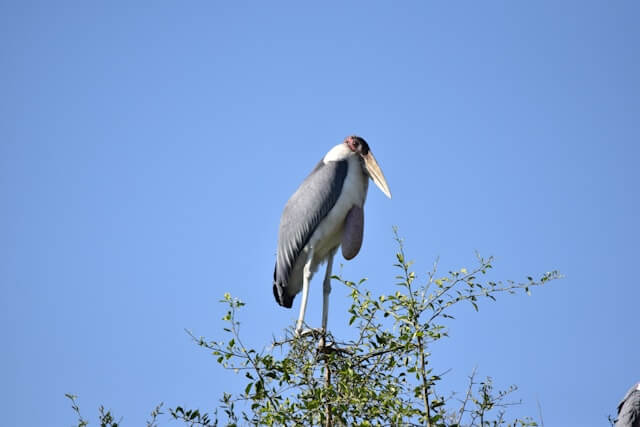
The marabou stork defecates upon its legs and feet. This ‘whitewash” has strong antiseptic properties, but beyond that, this act is used to regulate body temperature. This interesting cooling system is called ‘urohydrosis’ – the liquid works much the same way as sweat, through evaporative cooling. The white on their legs then helps reflect the sun and cool the bird down.
Lastly, what would you imagine Marilyn Monroe and marabou storks have in common? Well, she wore marabou-trimmed heels in the 1955 classic ‘The Seven Year Itch’!! Who knew??
Jacqui Ikin & The Cross Country Team